
Why PP FRP Scrubbers Are Ideal for Chemical Fume Treatment
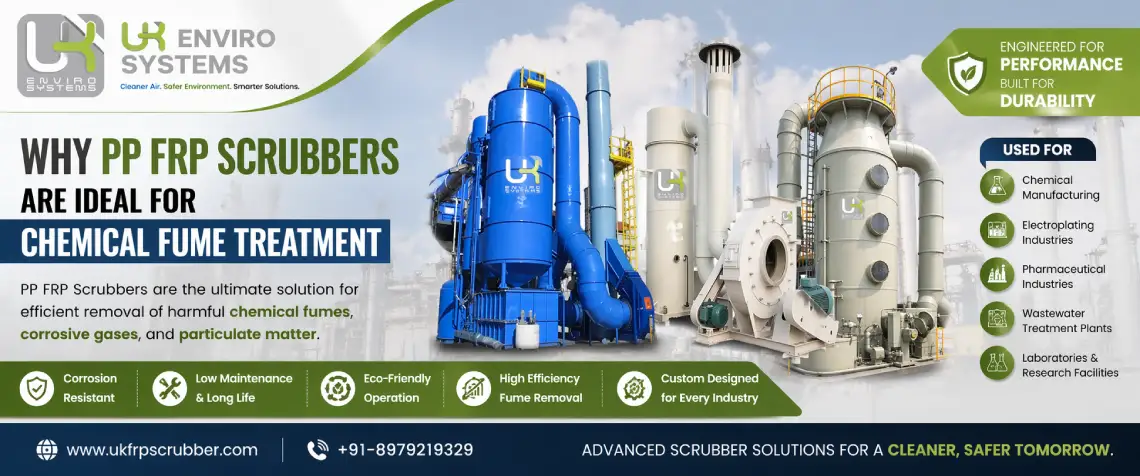
Table of Contents
TogglePP FRP Scrubber Systems in India
Chemical fumes pose serious risks to workers and the environment. Many industries struggle to control these hazardous emissions. PP FRP Scrubber Systems in India offer a reliable solution. UK Enviro Systems provides these advanced systems worldwide. Our scrubbers effectively remove toxic gases and corrosive fumes. They protect both people and our planet.
Chemical plants release aggressive vapors daily. These fumes can damage equipment quickly. They also harm respiratory health. Traditional metal scrubbers often fail in such conditions. That is why we recommend PP FRP technology. This combination delivers unmatched durability and performance.
Understanding the Challenge of Chemical Fumes
Industrial processes generate harmful airborne compounds. These include acids, solvents, and volatile organics. Each substance requires specific treatment methods. Without proper control, fumes escape into the atmosphere. Consequently, regulatory fines and health issues arise.
Corrosive Nature of Industrial Emissions
Many chemical fumes contain strong acids. Hydrochloric and sulfuric acids are common examples. These substances corrode standard metals rapidly. Rust and pitting appear within weeks. Eventually, equipment leaks or collapses entirely. This creates safety hazards and costly downtime.
Why Standard Materials Fail
Mild steel cannot resist acid attacks. Stainless steel performs better but still suffers. Chlorides and fluorides cause stress corrosion cracking. Additionally, high temperatures accelerate material degradation. Therefore, conventional scrubbers need frequent replacement.
The PP FRP Solution
PP FRP combines polypropylene and fiberglass. Polypropylene offers excellent chemical resistance. Fiberglass provides structural strength and rigidity. Together, they form a superior composite material. This material withstands harsh chemical environments effortlessly.
The Unique Composition of PP FRP Scrubbers
Understanding the material helps appreciate its benefits. Polypropylene (PP) is a thermoplastic polymer. It resists most acids, alkalis, and solvents. Fiberglass Reinforced Plastic (FRP) adds mechanical reinforcement. The result is a lightweight yet tough structure.
Polypropylene and Fiberglass Reinforced Plastic
PP serves as the inner lining. It contacts the corrosive fumes directly. FRP wraps around the outer layer. This combination prevents delamination and cracking. Manufacturers can mold complex shapes easily. Consequently, designers achieve optimal gas flow patterns.
Synergy of Two Strong Materials
Each material compensates for the other’s weakness. PP alone lacks structural rigidity. FRP alone may degrade chemically over time. Together, they create a perfect balance. This synergy extends equipment lifespan significantly. Many PP FRP scrubbers last over fifteen years.
Key Benefits for Chemical Fume Treatment
PP FRP Scrubber Systems in India deliver multiple advantages. Let us examine each benefit in detail.
Exceptional Corrosion Resistance
These scrubbers handle the most aggressive chemicals. Examples include chlorine, ammonia, and hydrogen sulfide. The PP surface remains unaffected by pH extremes. Furthermore, the material resists oxidation and reduction reactions. Consequently, maintenance costs drop dramatically.
High Temperature Tolerance
PP FRP withstands temperatures up to 80°C continuously. Short-term spikes up to 100°C cause no damage. This range covers most chemical fume applications. For higher temperatures, we offer specialized variants. Thus, you get reliable performance under thermal stress.
Lightweight Yet Durable
PP FRP weighs much less than steel. A single person can lift small scrubber components. Installation requires no heavy cranes or rigging. Nevertheless, the material offers high impact resistance. It does not crack or shatter under normal use. Shipping costs also reduce due to lower weight.
Cost-Effective Maintenance
Cleaning PP FRP surfaces is straightforward. Most chemical residues rinse away with water. No special solvents or tools are needed. Additionally, the material resists scaling and fouling. This reduces annual maintenance hours by half. Consequently, plant operators save significant money over time.
How PP FRP Scrubbers Work
These systems use wet scrubbing technology. Contaminated air enters the scrubber bottom. Then it rises through a packed bed section. Meanwhile, scrubbing liquid sprays from the top. Gas and liquid flow in opposite directions. This counter-current design maximizes contact time.
Packed Bed Technology
The packed bed contains specialized media. Common media include Pall rings and saddles. These shapes create a large surface area. Fumes must navigate through tortuous paths. Simultaneously, liquid coats every media surface. Pollutants transfer from gas to liquid phase.
Gas-Liquid Interaction
Three mechanisms remove contaminants from air. First, absorption dissolves gases into liquid. Second, adsorption binds compounds to liquid films. Third, impaction captures fine particles. PP FRP Scrubbers excel at all three processes. As a result, removal efficiencies reach 99% or higher.
Removal Efficiencies
Acid mists reduce to below 5 ppm. Ammonia levels drop from 1000 ppm to 10 ppm. Organic vapors also decrease substantially. For specific applications, we add chemical reagents. Sodium hydroxide neutralizes acid gases. Sodium hypochlorite oxidizes reduced sulfur compounds. Consequently, stack emissions meet all environmental standards.
Comparing with Other Scrubber Types
Not all scrubbers perform equally. Let us compare PP FRP against alternatives.
Versus Mild Steel Scrubbers
Mild steel costs less initially. However, corrosion destroys it quickly. Replacement every two years becomes common. PP FRP lasts five times longer. Therefore, lifecycle costs favor composite scrubbers.
Versus Stainless Steel
Stainless steel resists many chemicals. But it fails against chlorides and fluorides. Pitting and cracking appear in welded areas. Repairs require specialized welding techniques. PP FRP avoids these problems entirely. Moreover, stainless steel costs three times more. So PP FRP offers better value for chemical fumes.
Versus Plastic-Only Scrubbers
Some scrubbers use only polypropylene. These units lack structural strength. Wind loads and vibration cause cracking. Large diameters require thick walls. PP FRP Scrubber Systems Manufacturers reinforce the design with FRP. Hence, you get rigidity without excessive weight.
Role of PP FRP Scrubber Systems Manufacturers
Choosing the right manufacturer matters greatly. PP FRP Scrubber Systems Manufacturers must follow strict quality standards. UK Enviro Systems leads this field globally. We design each system for your specific fumes.
Importance of Quality Manufacturing
Poor fabrication leads to premature failure. Voids and bubbles in the FRP layer cause leaks. Improper curing reduces chemical resistance. Inadequate thickness allows warping under heat. Consequently, only experienced manufacturers should produce these scrubbers.
Customization Capabilities
Every chemical plant has unique requirements. Gas volumes vary from 500 to 50,000 CFM. Pollutant concentrations range from ppm to percent levels. Temperature and humidity also affect design. Therefore, we customize every aspect of the scrubber. This includes size, media type, and liquid circulation rate.
Design Verification
We use computational fluid dynamics (CFD) software. This tool simulates gas flow through the scrubber. It identifies dead zones and channeling issues. Then we optimize internal geometry accordingly. As a result, you get maximum contact efficiency. Field performance always matches our predictions.
Applications in Various Industries
Industrial Scrubbers serve many sectors. PP FRP technology applies wherever corrosive fumes exist.
Chemical Processing Plants
These facilities produce acids, bases, and solvents. Reactor vents release toxic byproducts. Storage tank breathes discharge vapors. Our scrubbers capture over 99% of emissions. Consequently, workers breathe cleaner air. Community complaints about odors also decrease.
Pharmaceutical Manufacturing
Drug synthesis generates volatile organic compounds. Methylene chloride and methanol are common examples. Gas Scrubbers remove these solvents effectively. Simultaneously, they control dust from tablet coating. This protects both employees and nearby residents.
Metal Finishing and Plating
Electroplating baths release acid mists. Chrome plating produces hexavalent chromium fumes. This substance causes lung cancer. Fume Scrubbers provide essential protection. They capture chromium below 0.005 mg/m³. Consequently, facilities comply with OSHA standards.
Fertilizer Production
Ammonia and urea plants release nitrogen compounds. These create smog and acid rain. Air Scrubbers recover ammonia as ammonium sulfate. This byproduct becomes useful fertilizer. Therefore, scrubbers turn pollution into profit.
Integration with Activated Carbon Towers
Some fumes require polishing after wet scrubbing. Activated Carbon Towers provide this final treatment. These towers adsorb residual organic vapors. They also remove odors completely.
How Carbon Towers Complement PP FRP Scrubbers
Wet scrubbers remove soluble and acidic gases. However, some hydrophobic compounds remain. Activated carbon captures these stubborn molecules. The carbon bed holds them until regeneration. Consequently, overall removal exceeds 99.9%.
Typical Two-Stage Systems
First stage uses a Packed Bed Scrubber. This removes HCl, NH3, or SO2. Second stage passes through an Activated Carbon Tower. This eliminates benzene, toluene, and xylene. Many pharmaceutical and coating plants use this setup.
Carbon Regeneration Options
Spent carbon can be thermally regenerated. This reactivates adsorption capacity for reuse. Alternatively, we provide carbon replacement services. Fresh carbon arrives every six to twelve months. UK Enviro Systems handles both options.
Why Choose UK Enviro Systems
We specialize in Air Pollution Control Scrubbers. Our team has decades of hands-on experience. Every product meets international quality standards.
Engineering Excellence
We design for maximum uptime and safety. Pressure drop stays below 2 inches of water column. Liquid coverage exceeds 80% of bed area. Mist eliminators capture droplets above 5 microns. Consequently, you get consistent performance year after year.
Comprehensive Support Services
Installation supervision comes standard with every purchase. We train your operators thoroughly. Annual maintenance contracts are also available. Emergency repairs reach your site within 48 hours. Thus, you never face extended downtime.
Global Track Record
Our PP FRP Scrubber Systems in India serve customers worldwide. Textile mills in Bangladesh use our units. Refineries in the Middle East depend on them. Metal finishers in Europe trust our technology. Each success story proves our reliability.
Sustainable Manufacturing
We recycle all production waste materials. FRP scraps become filler for non-structural parts. Water used in testing gets treated before discharge. Consequently, our operations leave a minimal environmental footprint.
Conclusion
Chemical fume treatment demands robust equipment. PP FRP Scrubber Systems in India meet this challenge perfectly. They resist corrosion, handle high temperatures, and last for decades. Leading PP FRP Scrubber Systems Manufacturers like UK Enviro Systems deliver custom solutions. Our Air Scrubbers, Gas Scrubbers, and Fume Scrubbers protect your workforce and community. We combine Wet Scrubbers with Activated Carbon Towers for complete removal. Choose UK Enviro Systems for your next Industrial Scrubbers project. Contact our engineering team today. Get a free consultation for your chemical fume needs. Safety and compliance start with the right equipment. Make the smart choice with PP FRP technology.