
The Role of Industrial Fume Scrubbers in Pollution Control
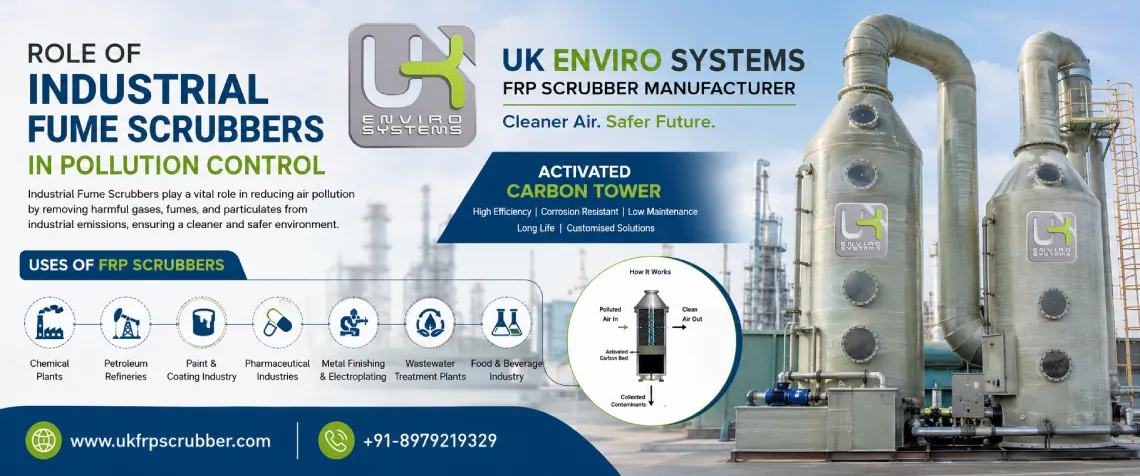
Table of Contents
ToggleIndustrial Fume Scrubbers Manufacturers
Modern industries face a serious challenge. They must control air pollution effectively. Industrial Fume Scrubbers Manufacturers play a vital role here. These manufacturers design systems that clean harmful gases. Their equipment protects our environment daily. At UK Enviro Systems, we understand this responsibility deeply. We deliver top-quality FRP Scrubbers worldwide. Our solutions help industries breathe easier. They also ensure compliance with strict laws. This blog explores how fume scrubbers control pollution. You will learn about their working principles. We will also discuss various types and technical specifications.
Understanding Industrial Fume Scrubbers
Industrial fume scrubbers are pollution control devices. They remove contaminants from exhaust streams. These systems handle gases, vapors, and particulates. Many industries rely on them heavily. For example, chemical plants produce toxic fumes. Metal finishing operations release acid mists. Pharmaceutical manufacturing generates volatile compounds. All these need effective scrubbing solutions.
Industrial Fume Scrubbers come in different designs. Each design targets specific pollutants. Some remove soluble gases efficiently. Others capture fine dust particles. The choice depends on your application. Therefore, selecting the right scrubber matters greatly.
How Do Fume Scrubbers Work?
The basic principle involves contact between gas and liquid. A scrubbing liquid absorbs or reacts with pollutants. Clean gas then exits the system. This process occurs inside a specially designed vessel. Wet Scrubber System designs use water or chemical solutions. They achieve high removal efficiencies for many contaminants.
Firstly, polluted gas enters the scrubber inlet. Then it passes through a spray zone. Nozzles create fine droplets of scrubbing liquid. These droplets capture pollutants effectively. Subsequently, the cleaned gas rises upward. Meanwhile, contaminated liquid collects at the bottom. Finally, treated gas releases into the atmosphere. The liquid undergoes treatment or disposal separately.
Chemical Fume Scrubber systems often use alkaline or acidic solutions. They neutralize hazardous compounds through chemical reactions. For instance, caustic soda removes hydrogen chloride gas. Similarly, sulfuric acid captures ammonia vapors. This chemical absorption ensures complete pollutant removal.
Technical Specifications of Industrial Fume Scrubbers
Every scrubber comes with defined technical parameters. These specifications determine performance and suitability. Below are critical technical details for various systems.
Removal Efficiency Ranges
A Pollution Control Scrubber typically achieves 95% to 99.9% efficiency. For highly soluble gases like ammonia, efficiency exceeds 99%. For poorly soluble compounds like methane, efficiency drops below 30%. Industrial Gas Scrubber designs target specific pollutants. Engineers select scrubber type based on required efficiency.
Pressure Drop Values
Pressure drop affects energy consumption directly. A Wet Scrubber System operates at 2 to 8 inches of water column. Venturi Scrubber System designs create higher drops. Values range from 10 to 60 inches of water column. Higher pressure drop means more fan power. Therefore, efficiency gains must justify energy costs.
Liquid-to-Gas Ratio Specifications
Packed Bed Scrubber systems use a liquid-to-gas ratio. This ratio ranges from 1 to 10 liters per cubic meter. For acid gas removal, ratios stay near 3 L/m³. For dust collection, ratios reach 8 L/m³. Too low a ratio reduces efficiency. Too high a ratio causes flooding and liquid carryover.
Temperature and pH Limits
Corrosion Resistant Scrubber materials withstand specific ranges. FRP handles temperatures up to 100°C (212°F). Polypropylene limits to 80°C (176°F). PVDF withstands 120°C (248°F). pH ranges vary by material as well. FRP works from pH 1 to 14. Stainless steel fails below pH 4. Always match material to your chemical stream.
Packing Media Technical Data
Packed Bed Scrubber internals use various packing types. Random packings include Raschig rings and Pall rings. Sizes range from 1 inch to 3 inches. Surface area varies from 100 to 350 m²/m³. Void fractions stay between 0.7 and 0.95. Structured packings offer even higher surface area. They reach 500 m²/m³ with lower pressure drop.
Types of Industrial Scrubber Systems
Many variations exist for different applications. Understanding these types helps you choose wisely. Below are the most common industrial scrubber systems.
Wet Scrubber System
A Wet Scrubber System uses liquid to capture pollutants. It works exceptionally well for soluble gases. Examples include ammonia, chlorine, and sulfur dioxide. These systems also remove dust and mists effectively. They offer high efficiency with relatively low cost. However, they produce wastewater that needs treatment.
Technical specification: Standard wet scrubbers handle gas flows from 500 to 100,000 CFM. Droplet sizes range from 200 to 500 microns. Removal efficiency for particles above 2 microns reaches 90%.
Venturi scrubbers belong to this category. They use high-velocity gas streams. Liquid atomizes into tiny droplets. This design captures submicron particles efficiently. Many industries prefer venturi scrubbers for sticky dust.
Venturi technical spec: Throat velocities reach 60 to 120 m/s. Droplet sizes drop to 10 microns. Particle removal efficiency for 0.5-micron dust reaches 98%.
Packed Bed Scrubber
Packed Bed Scrubber designs feature a tower with packing media. The packing increases surface area for gas-liquid contact. Common packing materials include polypropylene and ceramic. This design works best for gas absorption and chemical reactions.
Industrial operations use packed towers extensively. They handle corrosive gases like hydrogen sulfide. They also remove volatile organic compounds (VOCs). The efficiency depends on packing height and liquid flow rate. Consequently, engineers design each system specifically.
Technical specification: Packing heights range from 1.5 to 6 meters. Superficial gas velocity stays between 0.5 and 2 m/s. HETP (Height Equivalent to Theoretical Plate) varies from 0.3 to 1 meter. Number of transfer units (NTU) reaches 3 to 8 for acid gases.
Venturi Scrubber System
A Venturi Scrubber System creates a powerful pressure drop. Gas accelerates through a narrow throat. Liquid injected at this point atomizes instantly. Fine particles collide with droplets and get captured. This system excels for high-dust applications.
For example, foundries use venturi scrubbers for smoke control. Cement plants employ them for kiln exhaust. The energy consumption is higher than other types. But the particle removal efficiency is unmatched.
Technical specification: Throat length-to-diameter ratio is typically 3:1. Liquid injection pressure ranges from 30 to 100 psi. Particle cut diameter (d50) reaches 0.5 microns at 40 inches pressure drop.
The Importance of FRP Fume Scrubber Manufacturers
FRP Fume Scrubber Manufacturers produce equipment from fiber-reinforced plastic. FRP offers excellent corrosion resistance. It withstands aggressive chemicals easily. This material also provides lightweight construction. Installation and maintenance become simpler as a result.
FRP Scrubber Manufacturer expertise ensures long-lasting performance. FRP does not rust like carbon steel. It resists acid attack better than stainless steel. Many chemical plants prefer FRP fume scrubbers. They handle hydrochloric acid, sulfuric acid, and nitric acid safely.
UK Enviro Systems specializes in FRP Fume Scrubber designs. Our products serve industries worldwide. We understand corrosion challenges intimately. Therefore, we build scrubbers that last decades. Our Corrosion Resistant Scrubber solutions reduce downtime significantly.
Technical specification for FRP scrubbers: Wall thickness ranges from 6 mm to 20 mm depending on diameter. Tensile strength reaches 150 MPa. Flexural modulus stays above 7 GPa. Temperature rating is -20°C to 100°C continuous. UV-resistant top coat adds 10+ years outdoor life.
PP FRP Scrubber combinations offer additional benefits. Polypropylene provides chemical resistance. FRP adds structural strength. This hybrid design works for extreme conditions. Many customers choose this option for reliability.
PP/FRP hybrid spec: PP liner thickness is 3 to 5 mm. FRP outer layer adds 5 to 10 mm. Maximum operating temperature reaches 80°C. Chemical resistance includes all mineral acids up to 30% concentration.
Key Applications of Chemical Fume Scrubbers
Various industries need Chemical Fume Scrubber systems. Each application has unique requirements. Let us explore some common uses.
Acid Fume Scrubber for Chemical Plants
An Acid Fume Scrubber removes acidic gases from exhaust. Common targets include HCl, H2SO4, and HNO3 mists. These fumes cause equipment corrosion quickly. They also harm worker health severely. Proper scrubbing eliminates these risks completely.
Chemical manufacturing generates acid fumes continuously. Fertilizer production releases hydrogen fluoride. Battery plants emit sulfuric acid mist. Steel pickling lines produce hydrochloric acid vapor. All these need dedicated acid fume scrubbers.
Technical specification for acid service: Scrubber uses 5-10% caustic solution as scrubbing liquid. Removal efficiency for HCl reaches 99.5% at pH 8-9. Liquid circulation rate is 15-20 m³/h per 10,000 CFM. Make-up water consumption is 0.5-2% of circulation rate.
Industrial Gas Scrubber for Petrochemicals
Industrial Gas Scrubber systems treat hydrocarbon vapors. Refineries release benzene, toluene, and xylene. These compounds are toxic and flammable. Scrubbing with oil or special solvents captures them safely. Petrochemical facilities also use scrubbers for sulfur recovery.
Technical specification for VOC scrubbers: Use high-boiling point oil as absorption medium. Removal efficiency for BTEX compounds reaches 90-95%. Gas velocity stays below 1 m/s to prevent entrainment. Oil regeneration system recovers 98% of absorbed VOCs.
Industrial Exhaust Scrubber for Metal Finishing
Metal finishing operations produce hazardous exhaust. Plating lines generate cyanide and chromium mists. Anodizing releases phosphoric and sulfuric acids. Industrial Exhaust Scrubber systems handle these effectively. They protect workers and nearby communities.
Technical specification for chrome plating scrubber: Use sodium metabisulfite solution at pH 2-3. Chrome mist removal efficiency reaches 99.8%. Demister pads capture droplets down to 5 microns. Pressure drop across demister is 0.5 to 1 inch water column.
Benefits of Industrial Air Pollution Control Systems
Installing an Industrial Air Pollution Control System offers many advantages. Below are the most significant benefits.
Regulatory Compliance
Environmental agencies enforce strict emission limits. Failure to comply results in heavy fines. Pollution Control Scrubber systems help you meet these standards. They reduce emissions to legally acceptable levels. Consequently, your business avoids penalties and shutdowns.
Worker Safety
Toxic fumes endanger employee health directly. Long-term exposure causes respiratory diseases. Industrial Smoke Scrubber systems remove harmful particles. They create a safer workplace environment. Healthy workers are more productive and loyal.
Equipment Protection
Corrosive gases damage expensive machinery rapidly. Ductwork, fans, and controls suffer deterioration. Acid Fume Scrubber installation prevents this damage. Your equipment lasts longer with proper fume control. Maintenance costs decrease substantially over time.
Environmental Responsibility
Clean air is everyone’s right. Industries must minimize their ecological footprint. Air Scrubbing System technologies reduce harmful releases. They protect local ecosystems and communities. Sustainable practices improve your brand reputation.
Why Choose Corrosion Resistant Scrubbers?
Corrosion destroys ordinary scrubbers quickly. Acidic and alkaline fumes attack metal surfaces. Plastic materials resist this degradation effectively. Corrosion Resistant Scrubber designs use FRP, PP, or PVDF. These materials withstand harsh chemicals for years.
Industrial Scrubber System longevity depends on material selection. Mild steel scrubbers fail within months. Stainless steel lasts longer but costs more. FRP offers the best balance of cost and performance. It handles temperatures up to 100°C easily.
Additionally, FRP Fume Scrubber Manufacturers provide customization options. They design vessels for specific chemical environments. Nozzles, packing, and internals resist attack fully. This attention to detail ensures reliable operation.
Technical specification for corrosion resistance: FRP scrubbers pass ASTM C581 chemical resistance testing. Surface hardness reaches 35 Barcol after post-cure. Residual styrene content stays below 0.5%. Corrosion allowance is zero for properly selected resin.
Packed Bed Scrubber Efficiency Factors
Several factors affect Packed Bed Scrubber performance. Understanding these helps optimize your system.
Packing Material Selection
Random packings like saddles and rings work well. Structured packings offer lower pressure drop. Material choice depends on chemical compatibility. Polypropylene handles most acids and alkalis. Ceramic packing resists high temperatures. Metal packing suits non-corrosive gases only.
Packing technical data: Polypropylene packing density is 60-120 kg/m³. Surface area for 1-inch Pall rings is 205 m²/m³. Void fraction is 0.92. Pressure drop per meter of packing is 10-30 mm water column at 70% flooding.
Liquid-to-Gas Ratio
Higher liquid flow improves absorption efficiency. But too much liquid causes flooding. Proper ratio balances performance and cost. Engineers calculate this based on pollutant solubility.
L/G ratio specification: Minimum wetting rate is 0.1 m³/h per meter of packing width. For acid gas service, optimal L/G is 2-4 L/m³. For ammonia removal, L/G drops to 1-2 L/m³. Always check flooding point using generalized pressure drop correlation.
Gas Velocity
Gas speed affects contact time. Lower velocity increases removal efficiency. However, equipment size becomes larger. Higher velocity reduces size but may cause entrainment. Optimal velocity ranges from 0.5 to 2 m/s typically.
Velocity specification for packed towers: Design velocity is 60-80% of flooding velocity. For 1-inch random packing, flooding velocity is 2.5-3.5 m/s. Therefore, operating velocity stays between 1.5 and 2.5 m/s. Structured packing allows 20% higher velocity.
Industrial Odor Control System Integration
Many facilities need odor control alongside fume scrubbing. Industrial Odor Control System technologies remove smelly compounds. These include hydrogen sulfide, ammonia, and mercaptans. Chemical scrubbers with oxidizing agents work effectively.
Sodium hypochlorite solution destroys odorous gases. Hydrogen peroxide provides another option. Ozone injection oxidizes volatile compounds rapidly. Chemical Gas Scrubber designs incorporate these chemistries. They eliminate nuisance odors completely.
Technical specification for odor control: Two-stage scrubber uses acid then caustic-hypochlorite. H2S removal reaches 99.9% at pH 10-11. ORP (oxidation reduction potential) is maintained at 600-700 mV. Chlorine residual stays below 2 ppm in discharge.
The Future of Industrial Emission Control Systems
Technology continues advancing rapidly. Industrial Emission Control System designs become smarter and more efficient. Automation allows real-time monitoring and adjustment. Sensors detect pollutant breakthrough instantly. Control systems optimize liquid flow automatically.
Energy recovery features reduce operating costs. Heat exchangers capture waste heat from exhaust. This energy preheats incoming gas or water. Consequently, overall efficiency improves significantly.
Technical specification for smart scrubbers: pH and ORP sensors update every 2 seconds. Variable frequency drives adjust pump speed based on load. Scrubber responds to gas concentration changes within 30 seconds. Data logging includes 12 months of operational history.
Industrial Gas Scrubber manufacturers also focus on water conservation. Closed-loop systems recycle scrubbing liquid. Treatment units remove contaminants continuously. Fresh water consumption drops dramatically. Zero liquid discharge becomes achievable for many plants.
Water recycling spec: Settling tanks remove solids down to 50 microns. Filtration units achieve 5-micron clarity. pH neutralization automatic with 0.1 pH accuracy. Water bleed-off rate is 1-5% of circulation rate.
Selecting the Right FRP Scrubber Manufacturer
Choosing a reliable FRP Scrubber Manufacturer requires careful evaluation. Look for proven experience in your industry. Request references from similar applications. Verify material quality and fabrication standards.
UK Enviro Systems meets these criteria fully. We have decades of engineering expertise. Our Industrial Scrubbers Manufacturers team delivers customized solutions. Every system undergoes rigorous testing before shipment. We provide installation support and training as well.
Additionally, consider after-sales service quality. Spare parts availability matters greatly. Technical support responsiveness affects uptime. Our global network ensures prompt assistance always.
Specification for quality assurance: All FRP scrubbers meet ASME RTP-1 standards. Hydrostatic testing at 1.5x design pressure. Spark testing verifies no pinholes. Material certificates trace resin and glass batch numbers.
Conclusion
Industrial fume scrubbers play an essential pollution control role. They protect air quality effectively. Industrial Fume Scrubbers Manufacturers like UK Enviro Systems provide reliable equipment. FRP Fume Scrubber Manufacturers offer corrosion-resistant solutions. These systems remove acids, chemicals, and odors safely.
Investing in proper scrubbing technology benefits everyone. Your facility achieves regulatory compliance easily. Workers enjoy a healthier environment. Equipment lasts longer without corrosion damage. Most importantly, you contribute to a cleaner planet.
Contact UK Enviro Systems today for your fume scrubbing needs. Our Industrial Air Pollution Control System expertise ensures optimal results. We design Wet Scrubber System, Packed Bed Scrubber, and Venturi Scrubber System options. Let us help you control pollution effectively. Together, we can build a sustainable industrial future.