
Sewage to Sky Clean: Scrubbers for WWTP Emissions
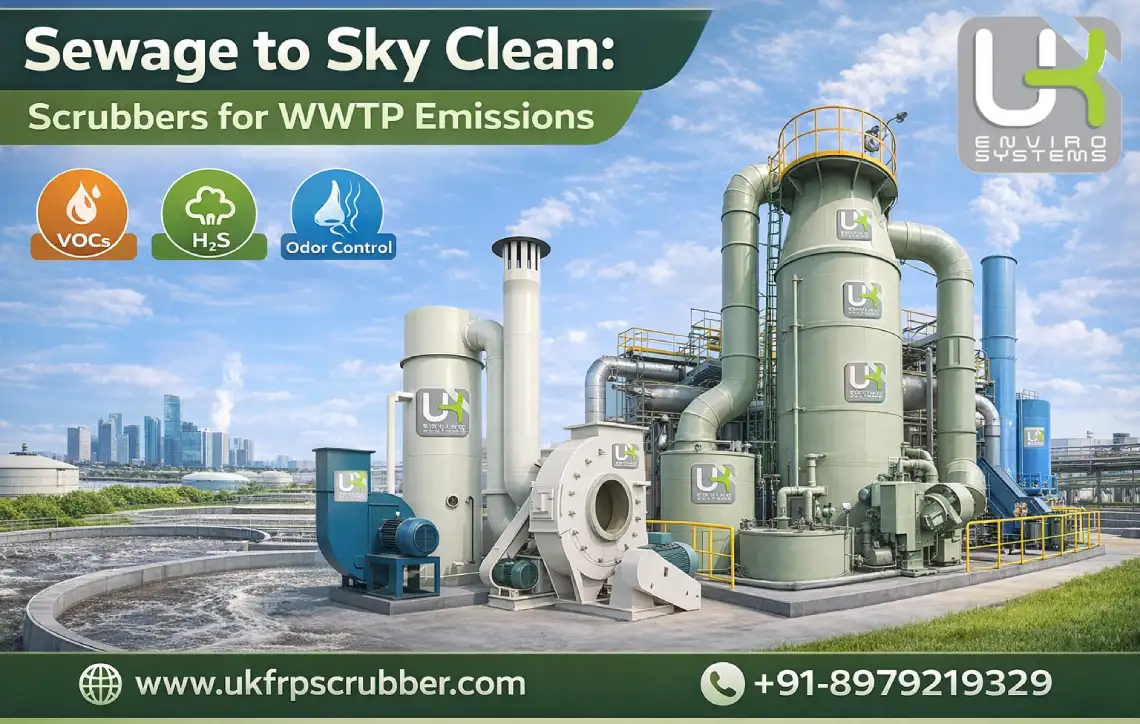
Table of Contents
ToggleScrubbers for WWTP Emissions
Wastewater treatment plants perform an essential service for communities. They clean our water before returning it to the environment. However, these facilities generate significant air emissions during the treatment process. Scrubbers for WWTP emissions provide the most effective solution for this challenge. These systems capture harmful gases and volatile organic compounds before they escape into the atmosphere. UK Enviro Systems understands this critical need. We dedicate ourselves to delivering top-quality industrial scrubbers to industries worldwide. Our mission transforms sewage treatment facilities from odor sources into responsible environmental stewards.
The Hidden Challenge of Wastewater Air Emissions
Wastewater treatment involves complex biological and chemical processes. These processes naturally release various gaseous compounds into the air. Hydrogen sulfide often tops the list of concerns. This gas produces that recognizable rotten egg smell. Ammonia, methane, and volatile organic compounds also escape during treatment stages. These emissions create nuisance odors for surrounding communities. More importantly, they pose potential health risks to plant workers and nearby residents.
Regulatory bodies worldwide now enforce stricter air quality standards. Wastewater facilities must comply with these evolving requirements. The pressure to control emissions continues to intensify. Plant operators need reliable technology that delivers consistent results. Scrubbers for WWTP emissions have emerged as the industry standard for meeting these demands.
Why Traditional Ventilation Falls Short
Many facilities once relied on simple ventilation systems. These systems diluted odors rather than eliminating them. Dilution proved ineffective for sensitive locations near residential areas. Stack heights increased to disperse gases higher into the atmosphere. Yet this approach merely moved the problem elsewhere. Communities grew less tolerant of odor complaints. Environmental agencies demanded actual removal rather than dispersion.
Modern solutions require actual contaminant capture and destruction. Ventilation alone cannot achieve this goal. True emission control demands engineered systems designed for chemical removal.
Understanding Scrubbers for WWTP Emissions
Scrubbers for WWTP emissions represent sophisticated air pollution control devices. These systems contact contaminated air streams with liquid solutions. The liquid absorbs or chemically reacts with target pollutants. Clean air then exits the system while contaminated liquid undergoes treatment or disposal.
Wastewater applications typically employ several scrubber configurations. Each design addresses specific emission profiles and operational requirements.
Wet Scrubbers for Soluble Contaminants
Wet scrubbers dominate the wastewater treatment sector. These systems excel at removing water-soluble gases like ammonia and hydrogen sulfide. The scrubbing liquid creates intimate contact with contaminated air streams. Packed towers represent the most common wet scrubber configuration.
Packed towers contain specialized media within vertical vessels. The media increases surface area for gas-liquid contact. Scrubbing liquid flows downward through the packed bed. Contaminated air moves upward against the liquid flow. This countercurrent arrangement maximizes removal efficiency.
Venturi scrubbers offer another effective option. These systems use high-velocity air streams to atomize scrubbing liquid. The resulting turbulent mixing captures submicron particles and soluble gases effectively. Venturi designs work well for applications with fluctuating contaminant loads.
Activated Carbon Towers for Persistent Compounds
Activated Carbon Towers provide complementary treatment for certain contaminants. Carbon adsorption captures organic compounds and residual odors that wet scrubbing may miss. These vessels contain granular activated carbon with extensive surface area. Contaminated air passes through the carbon bed. Target compounds adhere to the carbon surface through physical adsorption.
Wastewater facilities often combine wet scrubbers with carbon towers. This approach delivers comprehensive treatment across diverse emission profiles. The wet scrubber handles high-concentration soluble gases. The carbon polisher removes remaining trace compounds and odors.
Fume Extraction Systems for Safety
Fume Extraction Systems protect worker safety in enclosed treatment areas. Headworks buildings, sludge handling rooms, and chemical storage areas require localized extraction. These systems capture contaminants at their generation points. Dedicated ductwork conveys captured fumes to central scrubbers.
Proper fume extraction prevents hazardous gas accumulation in occupied spaces. Hydrogen sulfide poses particular risks in confined areas. Even low concentrations can cause serious health effects. Extraction systems maintain safe working conditions while feeding contaminants to treatment equipment.
The Critical Role of FRP Scrubber Manufacturers
Equipment durability proves essential for wastewater applications. Treatment plant environments contain corrosive gases and chemicals. Standard metal construction quickly succumbs to this aggressive atmosphere. This reality explains the importance of specialized FRP Scrubber Manufacturers.
FRP stands for fiber-reinforced plastic. This composite material offers exceptional corrosion resistance. FRP construction withstands continuous exposure to hydrogen sulfide, chlorine, and acidic conditions. The material requires minimal maintenance compared to coated metals. Service life often exceeds twenty years with proper design.
Material Selection Advantages
FRP scrubbers provide several distinct advantages for wastewater facilities:
Corrosion resistance eliminates coating failures and premature replacement. The homogeneous material construction prevents pinhole leaks common in lined equipment. Lightweight properties simplify installation and foundation requirements. Thermal stability maintains performance across temperature variations. Custom fabrication accommodates unique site constraints and space limitations.
UK Enviro Systems partners with leading FRP scrubber manufacturers. This collaboration ensures our clients receive equipment built for wastewater service conditions. We specify materials matched to specific chemical exposures. Our designs incorporate accessibility features for inspection and maintenance.
Design Considerations for Optimal Performance
Effective scrubbers for WWTP emissions require careful engineering. Each facility presents unique challenges requiring customized solutions.
Contaminant Characterization
Understanding the emission profile drives proper equipment selection. Hydrogen sulfide concentrations vary widely between facilities. Ammonia loads depend on industrial contributions to collection systems. Volatile organic compounds reflect the service area characteristics. Comprehensive air sampling establishes baseline conditions for design.
Peak loading conditions deserve particular attention. Wet weather events often increase contaminant concentrations. Diurnal flow patterns create fluctuating emission rates. Scrubbers must handle maximum anticipated loads without breakthrough.
System Integration
Scrubbers rarely function as standalone equipment. Complete systems include ductwork, fans, instrumentation, and chemical feed equipment. Proper integration ensures reliable performance across operating ranges.
Variable frequency drives on fans accommodate changing air volumes. Redundant components provide reliability for critical applications. Automated controls adjust chemical feed based on monitored loads. Remote monitoring capabilities enable proactive maintenance.
Chemical Selection
Wet scrubbers require appropriate chemical reagents for target contaminants. Caustic solutions neutralize acidic gases like hydrogen sulfide and chlorine. Sodium hypochlorite oxidizes reduced sulfur compounds effectively. Acidic solutions capture ammonia and other alkaline gases.
Chemical selection impacts operating costs significantly. Proper dosing control minimizes chemical consumption while maintaining performance. Some facilities utilize biological treatment within scrubber systems. Biological oxidation reduces chemical requirements for certain applications.
Maintenance and Operational Excellence
Reliable performance requires committed maintenance programs. Industrial Air Scrubbers demand attention to several key areas.
Packed Tower Maintenance
Packed media requires periodic inspection for fouling. Biological growth can accumulate within packed beds. Scale deposits may form from hard water or chemical reactions. Both conditions reduce available surface area and increase pressure drop.
Media replacement intervals vary based on service conditions. Some facilities schedule media changes every three to five years. Others extend service life through regular cleaning protocols. Proper pretreatment of scrubbing liquid reduces scaling potential.
Carbon Changeout Schedules
Activated carbon has finite adsorption capacity. Carbon changeout occurs when the bed reaches saturation. Analytical monitoring determines breakthrough points. Some facilities maintain spare carbon vessels for continuous operation.
Spent carbon requires proper disposal or reactivation. Used carbon from wastewater applications often qualifies as hazardous waste. Disposal costs factor into total operational expenses.
Chemical Storage and Handling
Chemical storage systems require careful attention. Bulk storage tanks need secondary containment. Chemical feed pumps demand regular inspection and rebuilds. Safety showers and eyewashes protect personnel handling chemicals.
Economic Considerations
Scrubbers for WWTP emissions represent significant capital investments. However, these systems provide compelling economic returns.
Avoided Regulatory Costs
Regulatory compliance avoids substantial penalties. Environmental agencies levy fines for odor complaints and emission violations. Community relations suffer when odor issues persist. Property values near treatment plants can decline with persistent nuisance conditions.
Energy Efficiency Opportunities
Modern scrubber designs incorporate energy-saving features. Low-pressure-drop packing reduces fan energy requirements. Variable frequency drives match energy consumption to actual loads. Heat recovery options capture waste energy from exhaust streams.
Life Cycle Cost Analysis
Initial equipment cost represents only part of ownership expense. Operating costs include chemicals, energy, labor, and replacement components. Life cycle analysis identifies optimal solutions considering all cost factors. Higher efficiency designs often justify higher initial investments.
Future Trends in Emission Control
The wastewater industry continues advancing emission control technology. Several emerging trends deserve attention.
Enhanced Monitoring Capabilities
Continuous emission monitoring systems provide real-time performance data. These systems enable predictive maintenance approaches. Cloud-based platforms allow remote oversight from any location. Data analytics identify optimization opportunities previously invisible.
Integrated Treatment Approaches
Facilities increasingly combine multiple treatment technologies. Wet scrubbers followed by carbon adsorption provide comprehensive treatment. Biological treatment within scrubber systems reduces chemical requirements. Thermal oxidation offers destruction for certain organic compounds.
Sustainable Design Principles
Energy recovery and water conservation feature in modern designs. Recirculating scrubber systems minimize water consumption. Renewable materials appear in some equipment components. Carbon footprint considerations influence equipment selection.
Conclusion: A Clear Path Forward
Wastewater treatment facilities no longer need to compromise between operational effectiveness and community acceptance. Scrubbers for WWTP emissions provide proven technology for eliminating odors and harmful emissions. These systems protect worker safety while ensuring regulatory compliance.
UK Enviro Systems stands ready to support facilities worldwide. Our expertise spans the full range of industrial air scrubbers. We understand the unique challenges of wastewater applications. Our partnerships with leading FRP scrubber manufacturers ensure durable, reliable equipment. We deliver solutions that transform treatment plants from sources of concern into responsible neighbors.
The journey from sewage to sky clean requires commitment and expertise. Properly designed scrubbers make this transformation possible. Clean air benefits everyone connected to the treatment process. Neighbors enjoy pleasant surroundings. Workers breathe safely. The environment receives protection. This outcome represents the true measure of successful emission control.