
Pressure Drop & Airflow: Engineering the Bridge Between Centrifugal Blower and Scrubber
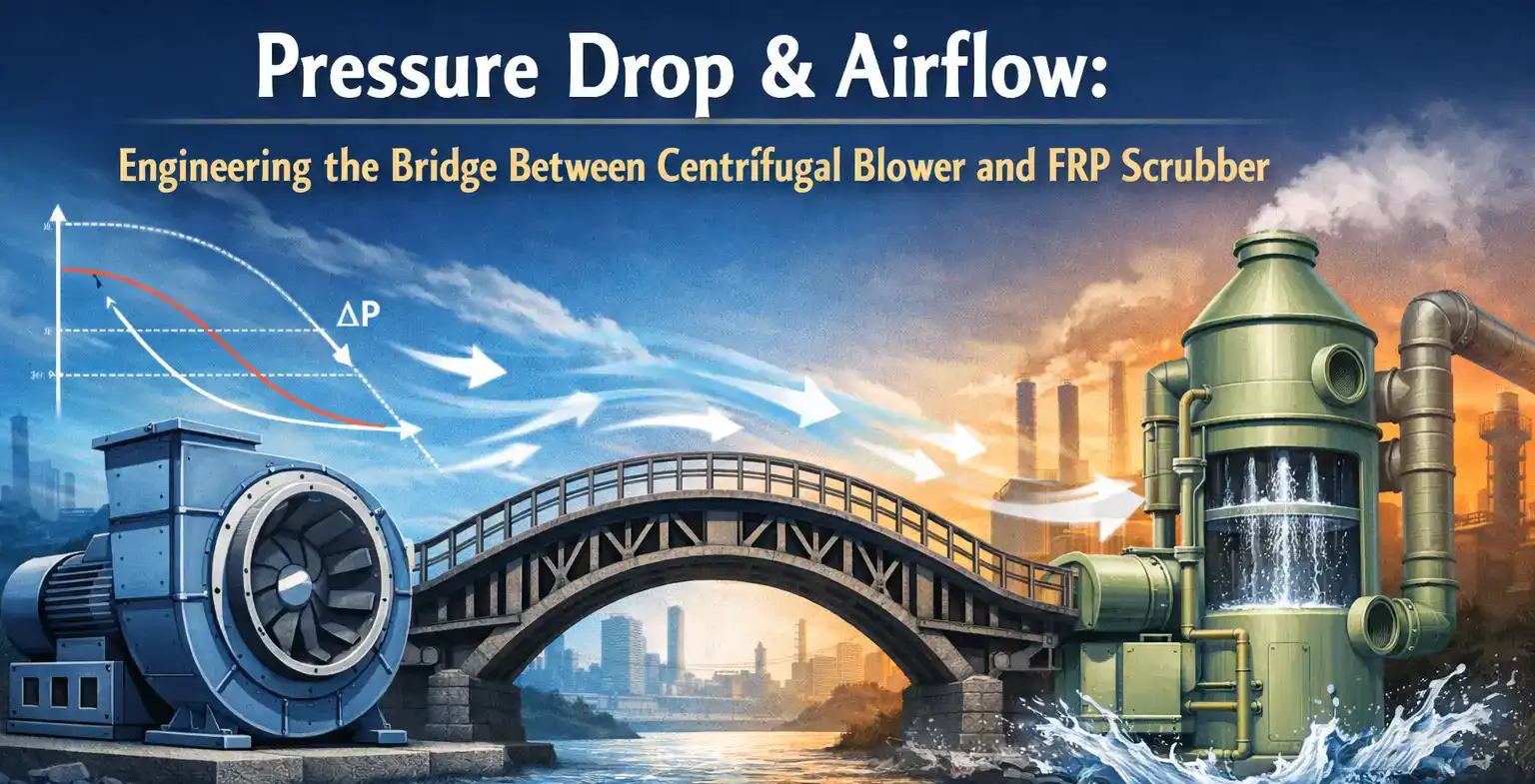
Table of Contents
ToggleCentrifugal Blower With FRP Scrubbers
Achieving peak performance in industrial air pollution control demands a seamless partnership. The relationship between a Centrifugal Blower With FRP Scrubbers is precisely that. It is a critical engineered bridge. This system’s effectiveness hinges on understanding two core concepts. These concepts are system pressure drop and managed airflow. Ignoring their interdependence leads to poor performance. Ultimately, this results in higher costs and compliance risks. This blog explores this vital engineering connection. We will provide actionable insights for optimizing your fume extraction system.
The Heart and Lungs of Your System: Defining the Roles
First, visualize your air pollution control system as a living organism. The FRP Exhaust Blower and Scrubber each play a distinct, vital role.
The Blower: The System's Heart
The centrifugal blower acts as the system’s heart. It creates the necessary force to move contaminated air. This force overcomes inherent resistance throughout the ductwork and equipment. Specifically, the blower generates both airflow (volume) and static pressure (force). Consequently, selecting the right blower is non-negotiable. Leading Centrifugal Blower Manufacturers focus on robust design. They ensure the blower provides a stable, reliable flow against varying resistance.
The Scrubber: The System's Lungs
Conversely, the FRP scrubber functions as the system’s lungs. It treats and purifies the contaminated airstream. Packed beds, mist eliminators, and liquid sprays create immense surface area. Therefore, gas absorption and particulate removal occur here. However, this intricate internal geometry also creates resistance. This resistance to airflow is the scrubber’s pressure drop.
Understanding the Critical Metric: System Pressure Drop
Pressure drop is the total resistance to airflow. It is measured in inches of water column (in WC) or Pascals (Pa). Essentially, it is the force your blower must overcome to move air. Importantly, pressure drop is not static. It changes with airflow velocity and system conditions.
Components Contributing to Total Pressure Drop
Your entire extraction system contributes to cumulative pressure drop. Main contributors include:
- Ductwork (length, diameter, bends)
- Hoods and enclosures
- The FRP scrubber vessel itself
- Demisting pads and packing media
- Exhaust stack
Furthermore, the scrubber often represents the largest single component of pressure drop. Meticulous calculation of each segment is crucial. Reputable FRP Scrubber Manufacturers provide accurate pressure drop curves. These curves are based on specific designs and packing types.
Airflow: The Lifeblood of Effective Treatment
Airflow, measured in cubic feet per minute (CFM), is the system’s lifeblood. It is the volume of air moved through the system per minute. Correct airflow is paramount for two reasons.
Ensuring Capture Velocity
First, sufficient airflow creates capture velocity at the hood. This velocity captures fumes at their source. Otherwise, contaminants escape into the workspace.
Optimizing Scrubber Empty Bed Contact Time
Second, airflow directly determines gas contact time within the scrubber. This is often called Empty Bed Residence Time (EBRT). Higher airflow shortens contact time. This reduction can severely decrease removal efficiency. Therefore, balancing capture needs with treatment requirements is an engineering imperative.
The Engineering Bridge: Matching Blower to Scrubber
The central challenge is matching the blower’s output to the system’s demand. This creates our engineering bridge. We must consider both pressure and flow simultaneously.
The System Curve: A Plot of Demand
Every Fume Extraction System in Ghaziabad or elsewhere has a unique “system curve.” This curve plots the relationship between airflow and pressure drop. Resistance increases with the square of the airflow. So, doubling airflow quadruples the pressure drop. Engineers plot this curve to visualize system demand.
The Blower Curve: A Plot of Supply
The centrifugal blower also has a performance curve. This curve shows its ability to generate pressure at various flow rates. The blower operates where its curve intersects the system curve. This intersection is the operating point.
Consequences of a Mismatch
A mismatch creates significant problems. An undersized blower cannot provide enough “push.” Consequently, it fails to achieve required airflow. This results in poor capture and treatment. An oversized blower, however, operates inefficiently. It wastes tremendous energy and can cause scrubber flooding. Additionally, it leads to excessive wear and noise.
Key Factors Influencing Scrubber Pressure Drop
Understanding what affects scrubber pressure drop allows for better design. Key factors include:
Packing Media Type and Depth
Denser packing offers more surface area for treatment. However, it also creates higher resistance. Engineers select media for optimal balance.
Liquid-to-Gas Ratio
Scrubbers irrigate packing with a recirculating liquid. The flow rate of this liquid impacts pressure. Higher liquid rates can increase drag on the airstream.
Fouling and Scaling Over Time
In operation, packing can accumulate particulates or scale. This accumulation gradually increases pressure drop. Therefore, monitoring this rise is a key maintenance indicator.
Optimizing the Bridge for Efficiency and Cost
Strategic optimization of this bridge yields major rewards. Focus on both design and operation.
Right-Sizing from the Start
Engage specialists early. Integrate the design of the blower and scrubber as one unit. This ensures harmony from the outset. Provide accurate process data to your Centrifugal Blower Manufacturers and FRP Scrubber Manufacturers.
The Role of Variable Frequency Drives (VFDs)
A VFD on the blower motor is a powerful tool. It allows you to adjust blower speed (RPM) to match exact demand. Thus, you can tune airflow without wasteful dampers. This saves substantial energy, especially in systems with variable flow.
Regular Maintenance Regime
Preventative maintenance stabilizes pressure drop. Regularly clean packing media and mist eliminators. Inspect and clean ductwork. Additionally, check spray nozzles for proper flow and pattern. This maintains design conditions.
System Balancing and Measurement
Install permanent pressure gauges across the scrubber. Monitor differential pressure routinely. Establish a baseline reading at commissioning. Then, investigate any significant upward drift immediately.
Advanced Considerations for System Design
For complex applications, deeper engineering analysis is needed.
Multi-Stage Scrubber Configurations
Some processes require multiple scrubber stages in series. Each stage adds to the total system pressure drop. Blower selection must account for this cumulative resistance precisely.
Handling Fluctuating Process Conditions
Process exhaust rates are not always constant. Engineers design for worst-case scenarios. They also implement control strategies. These strategies use VFDs or dampers to maintain performance across a range.
The Local Advantage: Expertise in Action
For industries in the region, leveraging local expertise is invaluable. Specialists in Fume Extraction Systems in Ghaziabad understand local environmental norms. They also grasp common industrial processes in the area. This local knowledge informs practical, compliant designs. Partnering with them ensures your blower-scrubber bridge is built on a foundation of relevant experience. They facilitate direct collaboration between blower and scrubber specialists. This collaboration is key to a unified, high-performance system.
Conclusion: Synergy for Success
Ultimately, the bridge between pressure drop and airflow is a testament to engineered synergy. The Centrifugal Blower With FRP Scrubbers must operate as a cohesive unit. Success depends on precise calculation, intelligent design, and proactive maintenance. You must view the blower and scrubber as interconnected components. One cannot function optimally without the other. By mastering their relationship, you ensure system reliability. You also guarantee treatment efficiency and achieve long-term operational savings. Therefore, invest in the engineering bridge. It connects your production process to clean, compliant, and sustainable air emissions.